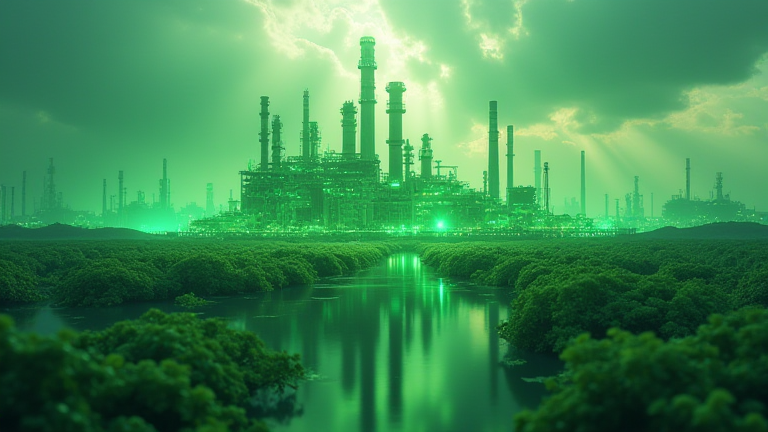
TL;DR: Green hydrogen, produced via electrolysis powered by renewable energy, is the most viable pathway to decarbonize hard-to-abate industrial sectors like steel, chemicals, and cement where electrification falls short. Recent leaps in electrolyzer efficiency, plummeting renewable costs, and major global project announcements have moved green hydrogen from pilot-stage curiosity to a cornerstone of industrial climate strategy.
Why Industry Needs Green Hydrogen
Heavy industry accounts for roughly a quarter of global CO2 emissions, yet many processes cannot simply plug into the grid. Steelmaking requires temperatures above 1,400°C and a chemical reducing agent; ammonia and methanol production depend on hydrogen feedstock; cement kilns demand intense, continuous heat. Green hydrogen—split from water using renewable electricity—addresses all three. It burns at high temperatures, serves as a clean chemical feedstock, and emits only water vapor when consumed. For sectors representing about 10% of global emissions, it is arguably the only scalable decarbonization tool available today.
If you want to dig deeper, check out our guide on Top 10 Natural Health Tips to Boost Your Energy Today.
Latest Technical Developments
Electrolyzer technology has advanced rapidly. Proton exchange membrane (PEM) systems now achieve efficiencies of 60–70% (LHV) with current densities exceeding 2 A/cm², while solid oxide electrolyzers (SOEC) push past 80% efficiency at high temperature, ideal for industrial sites with waste heat. Alkaline systems remain the cheapest at scale, with Chinese manufacturers driving stack costs below $200/kW. Meanwhile, next-generation alkaline and anion exchange membrane (AEM) designs are targeting capital costs under $100/kW by 2030. On the production side, the IEA tracks over 1,400 announced projects globally; the largest, such as NEOM in Saudi Arabia (2.2 GW) and HyDeal in Europe, are designed explicitly to supply steel and fertilizer plants. India’s National Green Hydrogen Mission and the U.S. 45V tax credit—up to $3/kg—have further accelerated deployment.
Industry Impact
Steel is the flagship: Sweden’s HYBRIT initiative has demonstrated direct reduced iron (DRI) using green hydrogen, with commercial plants planned for the mid-2020s. In chemicals, green ammonia projects are replacing fossil-based feedstock for fertilizers and shipping fuel. Refineries are substituting green hydrogen for gray hydrogen in hydrocracking. The economics remain challenging—green hydrogen costs $4–7/kg versus $1–2/kg for gray—but falling renewable prices, rising carbon levies, and scale-driven electrolyzer cost declines are closing the gap. Analysts project cost parity in favorable regions by 2030.
FAQ
Q: What makes green hydrogen different from blue or gray hydrogen?
A: Gray hydrogen is made from fossil gas and emits roughly 10 kg of CO2 per kg of H2; blue hydrogen captures most of those emissions but still relies on fossil feedstock; green hydrogen is produced by electrolysis using renewable electricity and emits essentially no CO2.
Q: Is green hydrogen economically viable for industry today?
A: Not universally—costs remain two to four times higher than gray hydrogen—but it is already competitive in niche cases with cheap renewables and high carbon prices, and parity is expected in leading regions by 2030 as electrolyzer costs fall.
Q: Which industries will adopt green hydrogen first?
A: Steel, ammonia/fertilizer production, and refining are leading because they already use large volumes of hydrogen and have clear technical pathways; cement and high-temperature heat applications will follow as technology matures.
Leave a Reply