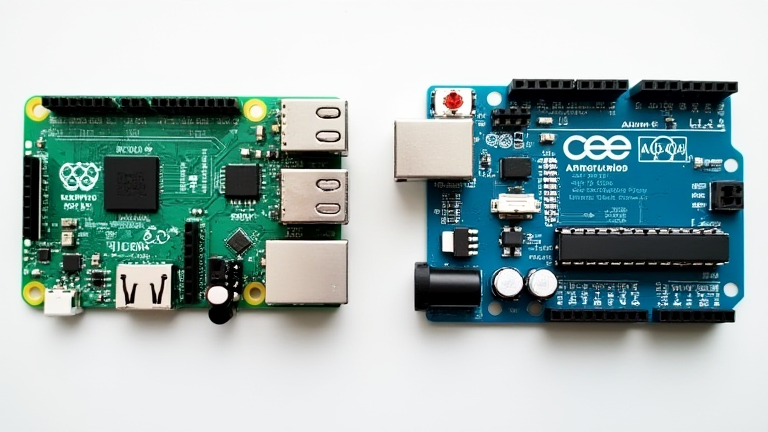
TL;DR: The Raspberry Pi 5 is a full-fledged Linux computer ideal for complex tasks involving operating systems, networking, and AI, while Arduino remains the superior choice for real-time, low-level hardware control and simple embedded logic. Your choice depends entirely on whether your project requires a complete OS environment or direct, deterministic pin manipulation.
Defining the Categories
Understanding the distinction between these two platforms is crucial for modern embedded systems design. The Arduino ecosystem is centered around microcontrollers, which are single-chip computers designed to execute specific tasks efficiently without the overhead of an operating system. In contrast, the Raspberry Pi 5 is a single-board computer (SBC) powered by the Broadcom BCM2712 processor. This fundamental architectural difference dictates their respective strengths and limitations in the current tech landscape.
If you want to dig deeper, check out our guide on Quantum Computing Breakthroughs Power Real-Time Drug Design.
Latest Developments and Specifications
The Raspberry Pi 5, launched in late 2023, represents a significant leap forward for the SBC market. It features a quad-core ARM Cortex-A76 processor running at 2.4 GHz, offering substantial improvements in single-core and multi-core performance over its predecessor. With 8 GB of LPDDR4X RAM as a top-tier option, it can comfortably handle desktop environments, complex data analysis, and even lightweight machine learning inference. The inclusion of a dedicated VideoCore 7 GPU and faster PCIe support further enhances its versatility for professional applications.
Meanwhile, the Arduino ecosystem continues to evolve with the introduction of more powerful boards like the Arduino Portenta H7, which features an STM32H743 processor. While it lacks the raw processing power of the Pi 5, it excels in real-time performance, consuming significantly less power and offering deterministic timing that is critical for industrial automation and sensor-driven robotics. The Arduino Uno, the classic entry-level board, remains relevant for educational purposes and simple IoT nodes due to its low cost and ease of use.
Industry Impact and Application Scenarios
The industry impact of these technologies is profound. The Raspberry Pi 5 is increasingly being adopted in edge computing scenarios, where local data processing is necessary to reduce latency and bandwidth usage. It is becoming a standard tool for prototyping digital signage, kiosk systems, and home automation hubs that require a user interface and internet connectivity. Its ability to run a full Linux distribution makes it a versatile development platform for software engineers.
Conversely, Arduino dominates in the realm of physical computing and industrial control. Its simplicity allows for rapid prototyping of sensors, actuators, and motors. In manufacturing, Arduino-based controllers are preferred for tasks requiring precise timing and low power consumption, such as conveyor belt monitoring or environmental data logging. The low cost and wide availability of components make it the backbone of STEM education worldwide, fostering the next generation of hardware engineers.
FAQ
Q: Can I replace an Arduino with a Raspberry Pi 5 for a simple LED blink project?
A: Yes, technically you can, but it is inefficient. The Pi 5 requires booting a full operating system, consuming more power and time, whereas an Arduino executes the blink command instantly with minimal resource overhead.
Q: Which device has better real-time performance for controlling a motor?
A: The Arduino is superior for real-time motor control. Microcontrollers offer deterministic timing and lower latency, which is critical for precise motor control, while the Raspberry Pi’s OS interrupts can cause unpredictable delays.
Q: Does the Raspberry Pi 5 require an SD card to operate?
A: Yes, the Raspberry Pi 5 typically boots from micro SD card storage. While newer firmware allows for booting from USB SSDs for better performance, an initial storage medium is required to load the operating system.
Leave a Reply