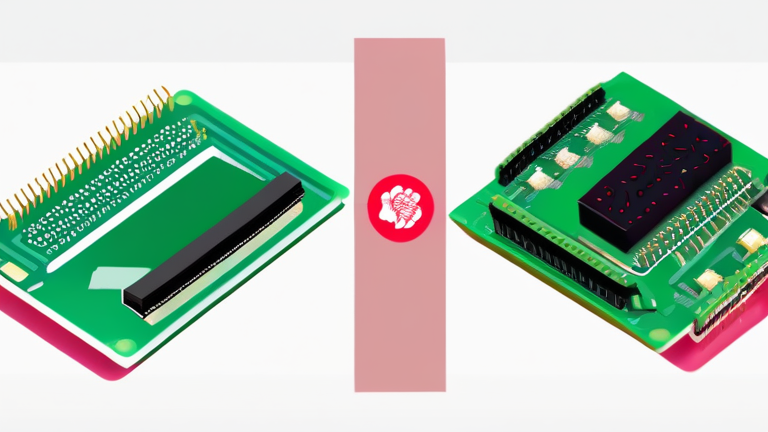
TL;DR: The Raspberry Pi 5 wins decisively for power users, offering a 2–3x CPU performance boost, PCIe 2.0 connectivity, and faster USB 3.0 speeds. However, the Raspberry Pi 4 remains the better choice for budget-conscious hobbyists or projects requiring low power draw and proven software stability.
The Silicon Leap: CPU and RAM
At the heart of the Raspberry Pi 5 is a quad-core Arm Cortex-A76 processor clocked at 2.4GHz, a massive architectural jump from the Cortex-A72 in the Pi 4. This translates to roughly 2.5x faster multi-threaded performance in real-world benchmarks like Geekbench 6. The Pi 5 also introduces a dedicated I/O controller chip, freeing the CPU from managing peripherals. RAM options now top out at 8GB (with a 16GB variant rumored), but the critical upgrade is LPDDR4X memory running at 4267MT/s—a 50% bandwidth increase over the Pi 4’s LPDDR4. For desktop use, compiling code, or running a lightweight LLM, the Pi 5 feels like a genuine PC; the Pi 4, meanwhile, still handles basic web browsing and retro gaming but stutters under heavy multitasking.
If you want to dig deeper, check out our guide on Sovereign AI Data Centers: The New Geopolitical Flashpoint.
Connectivity: PCIe Changes Everything
The Pi 5’s headline feature is a PCIe 2.0 x1 interface, exposed via a dedicated FPC connector. This allows for direct NVMe SSD attachment without USB bottlenecks—sequential read speeds jump from ~350MB/s (USB 3.0 on Pi 4) to over 900MB/s. That single change makes the Pi 5 viable as a network-attached storage (NAS) or database server. The Pi 5 also upgrades USB to dual USB 3.0 ports (up from one on the Pi 4), both running at 5Gbps, plus two USB 2.0 ports. Gigabit Ethernet is now native (no USB bridge), and the dual micro-HDMI outputs support 4K/60Hz on both ports simultaneously. The Pi 4, by contrast, caps at 4K/30Hz on one port and relies on a shared USB/Ethernet bus, which bottlenecks high-throughput I/O.
Power, Thermals, and Real-World Impact
The Pi 5 demands a 5V/5A (25W) USB-C power supply (or Power-over-Ethernet HAT), consuming up to 12W under load versus the Pi 4’s 7.6W. It runs hotter, too—the bundled active cooler is essential for sustained workloads, though idle power stays around 2.7W. Industry impact is significant: the Pi 5 has become the default for edge AI prototyping (via Hailo-8L M.2 accelerators), digital signage, and robotics, where the PCIe lane enables custom hardware. Meanwhile, the Pi 4’s lower price (often $35–$45 for 2GB) keeps it dominant in education and simple home automation. Software support is a differentiator: the Pi 4 enjoys rock-solid, mature drivers, while the Pi 5’s initial firmware had USB stability quirks—though recent updates have largely resolved these.
Verdict
Choose the Pi 5 if you need speed, storage expansion, or dual 4K output. Stick with the Pi 4 if your project is sensor-based, battery-powered, or budget-limited. Both are excellent, but the Pi 5 is undeniably the future-proof board.
FAQ
Q: Can I use my Raspberry Pi 4 power supply with the Pi 5?
A: No. The Pi 5 requires a 5V/5A (25W) USB-C supply, while the Pi 4 uses 5V/3A (15W). Using the Pi 4’s supply may cause undervoltage warnings and unstable USB or PCIe performance.
Q: Is the Raspberry Pi 5
Leave a Reply