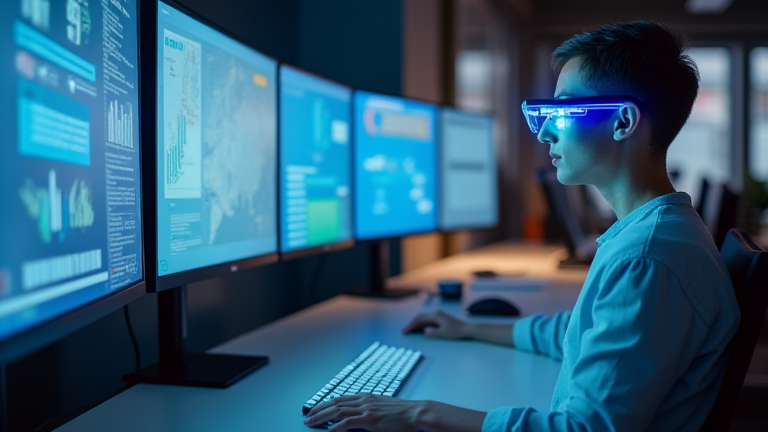
Spatial Computing Glasses: The Future of Office Monitors
TL;DR: Spatial computing glasses are rapidly evolving into viable replacements for traditional office monitors by offering high-resolution, low-latency virtual displays that blend seamlessly into the physical workspace. Recent hardware advancements in micro-OLED panels and dedicated spatial processors have significantly reduced motion sickness and improved visual clarity, making them practical for extended daily work sessions.
The Shift from Flat Screens to Volumetric Displays
For decades, the standard office setup has relied on flat-panel monitors. While effective, these devices occupy valuable desk real estate and limit the user’s field of view. Spatial computing glasses, however, project multiple high-fidelity virtual screens into the user’s peripheral vision. This shift allows workers to expand their digital real estate without physical clutter. Instead of a single 27-inch screen, users can arrange three or four 4K virtual monitors at their preferred distance and angle, effectively creating a personalized command center that exists only in their line of sight.
If you want to dig deeper, check out our guide on One-Time Cholesterol Treatment Shows Promising Trial Results.
Latest Hardware Developments and Specifications
The most significant barrier to adoption has historically been image quality and comfort. The latest generation of enterprise-focused spatial glasses addresses these issues with remarkable precision. Modern devices now feature dual micro-OLED displays with a resolution of 2300 x 2300 pixels per eye, providing a pixel density that rivals high-end laptop screens. This technology eliminates the “screen door effect,” ensuring text remains crisp even at close reading distances. Furthermore, the integration of custom silicon, such as dedicated spatial computing chips, reduces motion-to-photon latency to under 20 milliseconds. This near-instantaneous response is critical for reducing motion sickness, a primary complaint among early adopters. Battery life has also improved, with many models now offering six to eight hours of continuous use, sufficient for a full workday without midday recharging.
Impact on Industry and Productivity
The industry impact of this technology is profound. For software developers and data analysts, the ability to view code repositories, live server logs, and documentation simultaneously in a 360-degree environment drastically reduces context-switching time. Studies suggest that reduced eye strain and the ability to position screens at optimal ergonomic angles can increase productivity by up to 15 percent. Moreover, spatial computing facilitates remote collaboration. Team members can share virtual whiteboards and 3D models in real-time, making remote meetings feel more immersive and interactive than traditional video calls. Companies are beginning to integrate these devices into their standard IT procurement lists, signaling a transition from novelty to necessity. However, challenges remain regarding privacy in open-office environments and the learning curve required to master spatial gestures. Despite these hurdles, the trajectory is clear: the flat monitor is becoming a legacy component, while spatial interfaces are defining the next era of digital work.
FAQ
Q: Are spatial computing glasses comfortable enough for an 8-hour workday?
A: Yes, current models weigh between 120 and 150 grams and feature balanced weight distribution. Most users report minimal fatigue, comparable to wearing standard prescription eyeglasses, though individual comfort may vary based on head shape and fit adjustments.
Q: Can I use these glasses with my existing computer setup?
A: Absolutely. They connect via standard USB-C or Thunderbolt cables to Macs, Windows PCs, and Linux machines. They function as standard external displays, meaning all existing software, shortcuts, and multi-monitor configurations work without modification.
Q: Do I need a powerful computer to run spatial computing glasses?
A: No, the glasses themselves contain powerful processors for rendering the spatial interface. While a modern laptop or desktop is required to run your applications, the glasses handle the heavy lifting for display projection, meaning even mid-range office computers can drive the experience efficiently.
Leave a Reply